Turkey isn't just losing on price. Now it's losing on tariffs too.
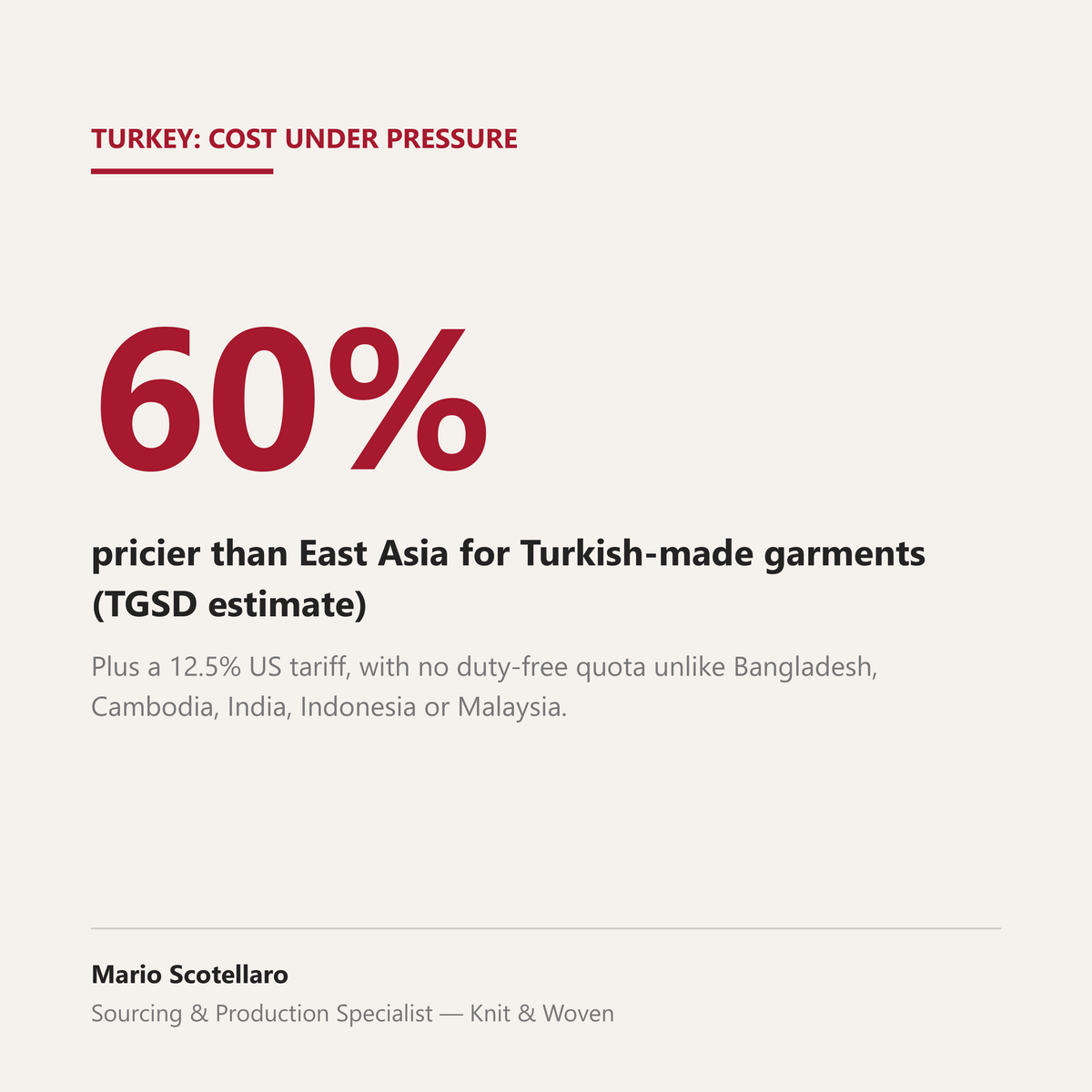
Turkey's currency has been sliding for years, but that hasn't made garments cheaper to export. Between 2022 and 2024, Turkish inflation rose 138% and the minimum wage rose 249%, while the lira devalued only 101%, according to Toygar Narbay, president of Turkey's Clothing Manufacturers' Association (TGSD). The currency didn't weaken fast enough to offset domestic costs: Narbay puts Turkish-made garments roughly 60% pricier than East Asian equivalents, 45% pricier than North African ones. The pressure hasn't eased. Apparel exports fell 4.36% in 2025, inflation stayed near 30% into mid-2026, and the sector lost about 121,800 jobs between December 2024 and May 2026.
Now a second, separate cost has landed on top. The new US Section 301 forced-labor tariff puts Turkey at 12.5%, above the 10% applied to Bangladesh, Cambodia, India, Indonesia and Malaysia. Unlike those four, Turkey got no access to the tariff-rate quota that lets them bring in duty-free volumes. USTR's stated reason: an insufficient system to prevent forced-labor imports.
Turkish exporters are pushing into the US market anyway. Shipments there grew 1.4% in 2025 to $1.4B, as Chinese apparel exports to the US are set to drop roughly a third and European demand softens. For anyone comparing FOB across production bases: Turkey isn't just losing on price, it's losing on cost structure and tariff treatment at the same time, which makes the US push look more like necessity than opportunity.
Sources: Turkish Minute, on TGSD data on inflation, wages and exchange rate 2022-2024 · Hertzman Global Intelligence · PolyesterTime, on the Section 301 tariff and employment data · Türkiye Today, on the TRQ exclusion · RaillyNews, on the US market push