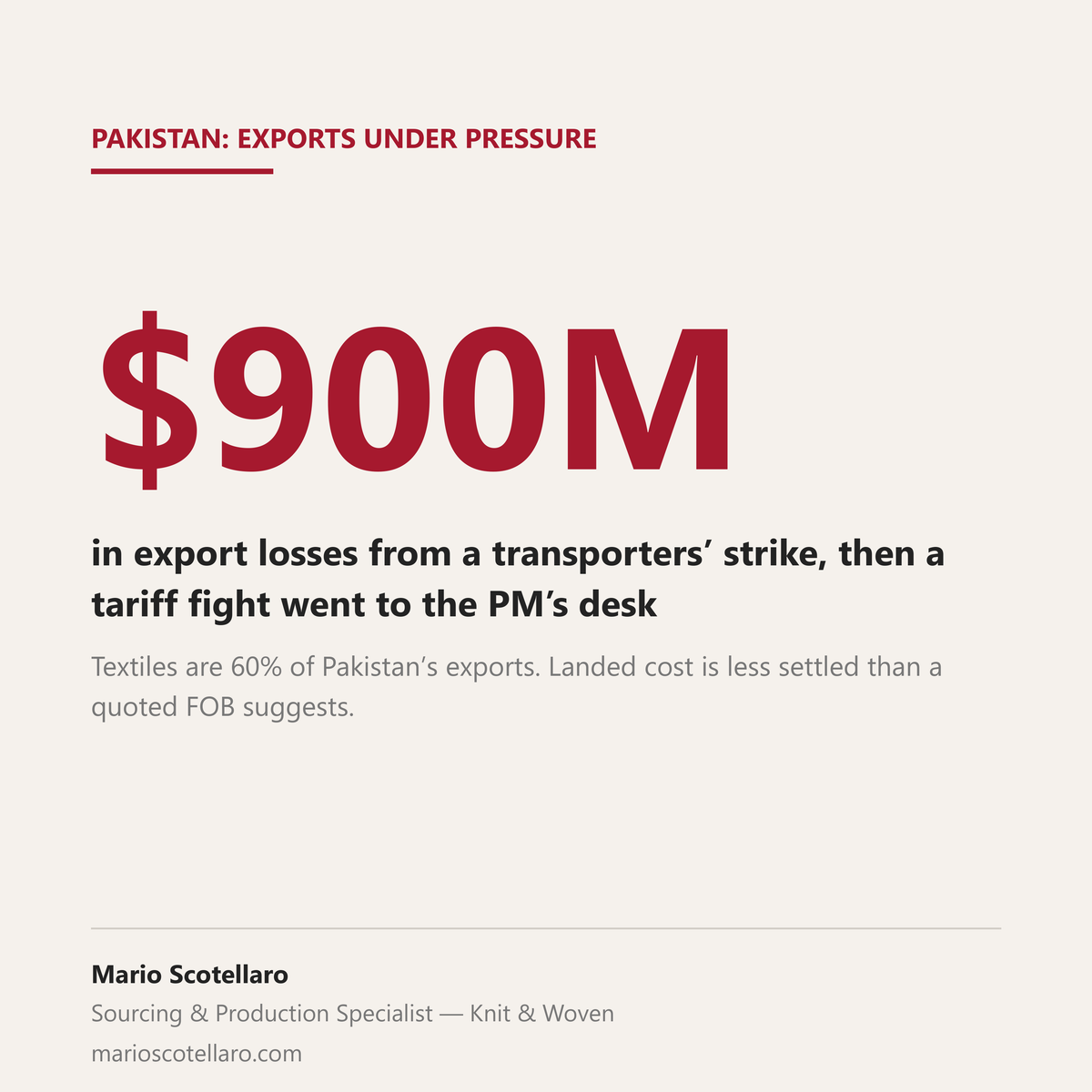
Pakistan lost $900M to a strike. Then a tariff fight went to the PM's desk.
Pakistan's textile exporters spent the first half of August absorbing a nine-day transporters' strike that left containers stranded at the ports. The Pakistan Textile Exporters Association (PTEA) puts the damage at close to $900 million in losses to exports and allied trade. Islamabad talked the transporters into suspending the action on 17 August, but the alliance's own president made the truce sound temporary: "We are not ending the strike, we are postponing it."
A second cost landed almost immediately after. On 22 August APTMA rejected a proposed fuel-charge increase of roughly 9 to 10% on top of the industrial electricity tariff already in force for July. Two days later PTEA went further, asking the Prime Minister's Office and the Special Investment Facilitation Council to intervene directly over what it calls an unresolved tariff anomaly. Their argument is straightforward: export orders are priced months in advance, and a sudden jump in energy costs has nowhere to go but into the exporter's margin.
Textiles account for more than 60% of Pakistan's exports, so a dispute over an electricity bill is not a side issue, it is the industry's cost base. When exporters ask the Prime Minister to referee a power tariff twice in ten days, and a transport strike is only "postponed" rather than resolved, the landed cost out of Pakistan is less settled than a quoted FOB suggests. Worth building a buffer into any costing that assumes today's numbers hold for the life of an order.
Sources: Business Recorder, on the transporters' strike (17 August 2026) · Profit/Pakistan Today, on the strike suspension (17 August 2026) · The News International, on APTMA's tariff rejection (22 August 2026) · Profit/Pakistan Today, on PTEA's request to the PM and SIFC (24 August 2026) · Profit/Pakistan Today, on the baseline industrial tariff (17 February 2026)