Cambodia and Bangladesh in the US: the split follows product more than country
US apparel imports from Cambodia and Bangladesh moved in different directions this year, and the split follows product more than country.
OTEXA, the US Department of Commerce textile data, now has figures to September 2026 (released 4 November). I took garments in man made fibres, where the two countries compete most closely, and split them into women's and men's.
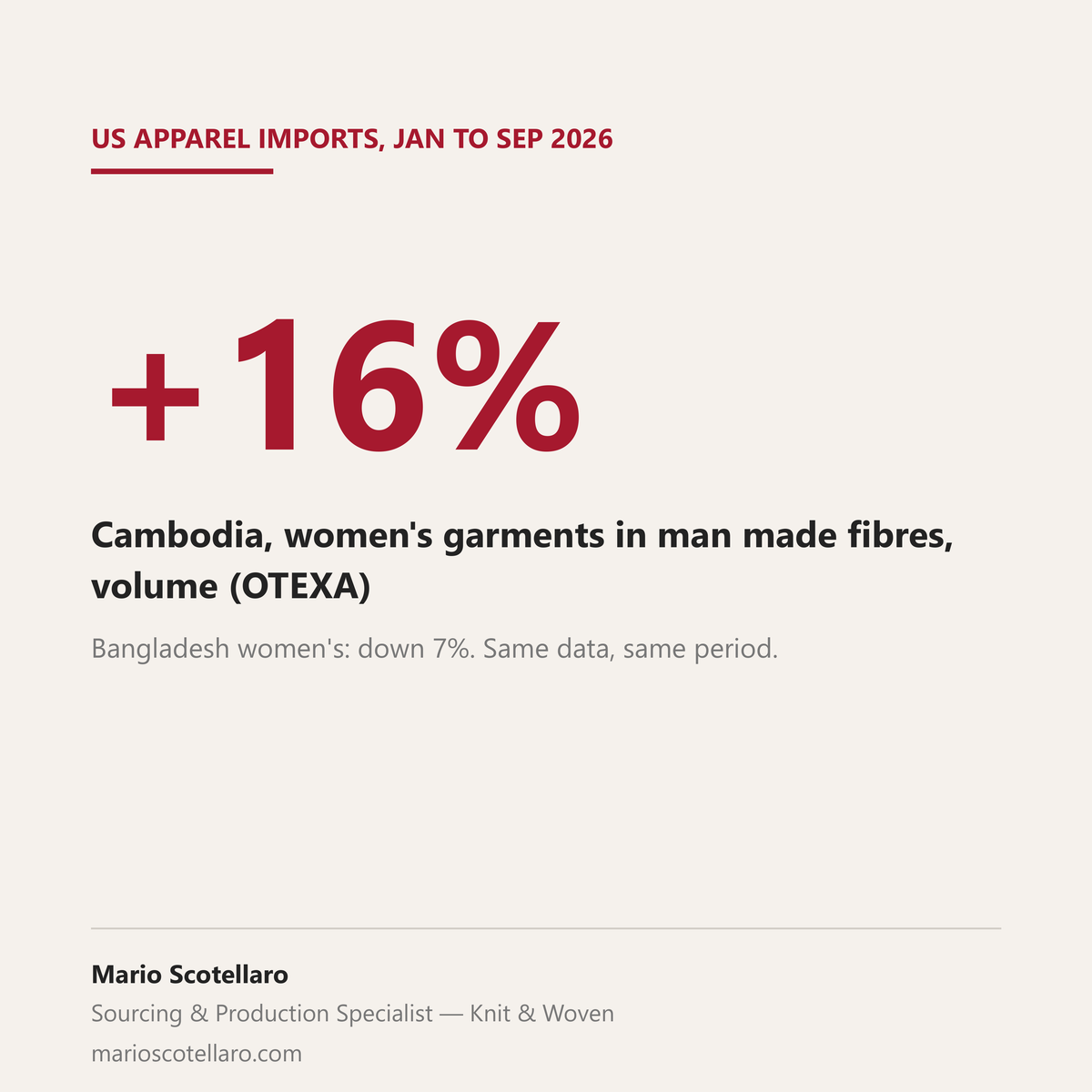
From January to September, Cambodia shipped 16% more women's garments to the US than a year earlier, measured in square metre equivalents. Men's were 1% lower. Bangladesh shipped 7% less women's and 13% less men's.
Women's share of the man made volume went from 61% to 64% for Cambodia, and from 39% to 40% for Bangladesh. So Cambodia's US business in these fibres is mostly women's, Bangladesh's is mostly men's, and the gap between them stayed wide. What moved is where the growth went.
Two things stop this from being a simple story. First, 2025 was a high base for both: in total apparel value, Bangladesh is still about 13% above January to September 2024, and Cambodia about 37%. Second, cotton looks different. Women's cotton grew in both countries, 12% for Bangladesh and 6% for Cambodia, while men's cotton fell in both, 7% and 4%.
These figures are an extraction from OTEXA data. They show what the US bought, not why.
For a brand placing a programme, and for a factory deciding where to push, the country total hides most of this. Both sides are better off looking at the same product split before they talk about volumes and price.
Sources: OTEXA, US textile and apparel imports by country, read 10 November 2026 · OTEXA monthly release schedule